If Not for Myself
On Hillel, the Carnation Revolution, and the universalism that skips its own foundation.

April 25th is Dia da Liberdade in Portugal, and we had the privilege of spending it in Porto. Being tourists, we went on a walking tour in the morning (complete with a cable car ride and boat ride on the Douro where you can see a bridge by Gustave Eiffel’s company). Our tour guide, Maria, was sporting a carnation... as were many, many locals. There were carnations everywhere. The Carnation Revolution is a symbol of the military coup that overturned the Portuguese dictatorship 52 years ago in 1974. It is always startling to remember that the Iberian Peninsula was run by dictators into my lifetime. While Franco was more brutal, living under António de Oliveira Salazar was no picnic.
Salazar suffered a stroke in 1968, and for two years thereafter, with the help of insiders, he “governed” a fictional Portugal. His successor, Marcelo Caetano, continued Salazar’s policies and refused to grant independence to the many Portuguese colonies as the modern nation-state system took hold. Holding on to them required a level of sacrifice and brutality that the Portuguese people were no longer interested in. The Carnation Revolution happened when, in 1974, a group of mid-level military officers, radicalized by their service in the colonies, overthrew the regime in an almost bloodless revolution. History has it that some women pinned carnations on the soldiers’ uniforms. We were in Portugal 52 years later, on the 25th of April, when the Portuguese annual celebration of their liberty is adorned with carnations, bagpipe music on a central stage, and dancing. It was multigenerational.
That evening, we went to a restaurant near our hotel, and the restaurant manager made sure we understood the significance of the day. He pointed out that under Salazar, cigarette lighters required a permit. This was Salazar’s protectionist scheme to support the local match industry, with a little self-dealing built in given that it was 25% state owned. (This policy does double offense to me given that I’m an economist.) But the dictatorship was much more serious. Women could only get their own passports with their husband’s permission. To keep dissidents from fleeing, exit visas were required to leave the country. Swimsuits were regulated for modesty, homosexuality was criminal, kissing in public was fined. Of course, the press was censored, stories needed to be approved. There was a secret police, detentions (before WWII they trained with the Gestapo), deaths. Kids were put into a mandatory youth organization. So, dictatorship stuff. It’s no wonder the 25th of April is an important day in Portugal.
Which is what made this image particularly interesting.
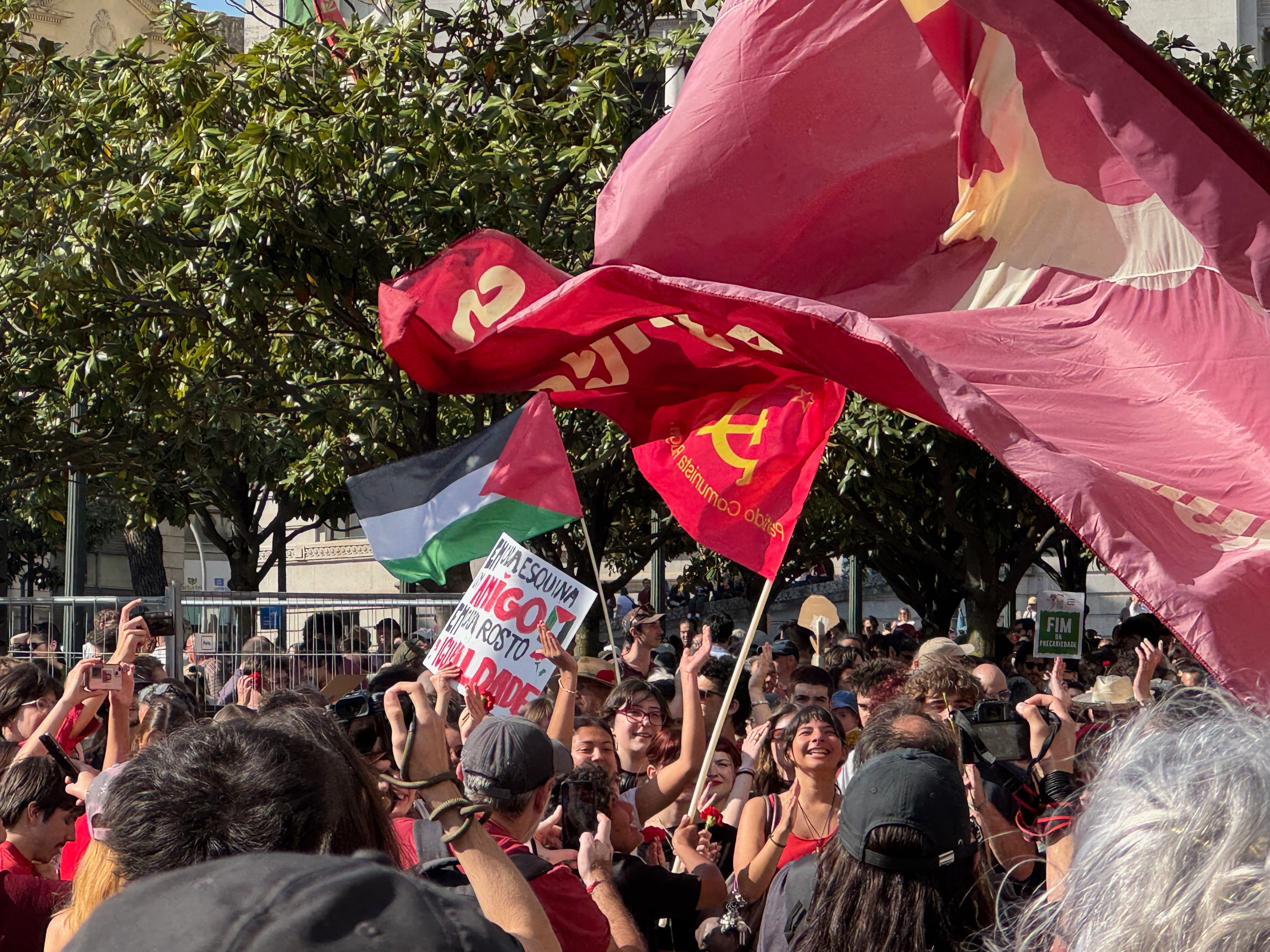
You can see the flags, two representing the communist party and the now very familiar Palestinian flag. As it happens, we were in an area with communist party supporters. The sign reads EM CADA ESQUINA UM AMIGO EM CADA ROSTO A IGUALDADE: “On every corner, a friend. On every face, equality.” This is a lyric from Zeca Afonso’s song whose 1974 broadcast signaled the start of the revolution. The song doesn’t refer to equality of outcomes, but sits inside a triad, (fraternidade, amigo, igualdade), that rhymes with the French liberté, égalité, fraternité. The idea is that everybody counts and we’re in this together, solidarity.
The layering of the Palestinian flag is then confusing, or, on closer inspection, illustrates the challenging logic of the Red-Green alliance - at least if this is what the protestors hope for the Palestinian people. Freedom for Palestinians is not just a problem of occupation. In Gaza, under Hamas, there is no freedom of the press, there have been no elections since 2006, there is arbitrary arrest, torture, and extrajudicial executions of dissenters (by Hamas for PA supporters in Gaza, and the PA for Hamas supporters in the West Bank). Posts critical of either authority are forbidden and prosecuted, there are restrictions on assembly, it is a capital crime to sell land to Jews, though in practice the sentence is hard labor for life, polygamy is legal, Sharia law applies to inheritance (women get 1/2 share of men). Virtue and morality police operate in Gaza, same-sex conduct is illegal in Gaza, technically not in the PA, though homosexual behaviors are taboo in Palestinian culture and gay people can expect extra-legal violence in each. Honor killings of women are real, pervasive, and under-prosecuted. “On every corner, a friend. On every face, equality”, or fraternidade-amigo-igualdade this is not.
Fraternidade, amigo, igualdade is a moral claim of mutual respect for all, and there is little evidence that fraternidade, amigo, igualdade are values common in Gaza and the West Bank, nor would they be if the Israeli occupation ended tomorrow. Herein lies the contradiction, the Red-Green alliance is not symmetrical. In 1979 the Tudeh communists and secular left backed Khomeini’s revolution; by 1983 the Tudeh was crushed and leadership executed. In Egypt the April 6 Movement and secular liberals backed the Muslim Brotherhood out of revolutionary solidarity but were sidelined immediately once the Brotherhood took power. Many fled Egypt altogether.
Of course, in Porto, it is safe to claim that waving the Palestinian flag is a statement of fraternidade, amigo, igualdade - if that is what the flag-bearer actually meant. But the realities of a “River to the Sea Palestine will be ‘Free’ (English version) or ‘Arab’ (Arabic version)” scenario are not very fraternidade-amigo-igualdade. And this will be of little direct consequence in Portugal - at least in the short run. And being a communist in 2026 Portugal is probably a costless expression that provides some meaning.
It’s interesting to note that the Red part of the Red-Green alliance has inverted Hillel’s proverb. Or perhaps just skipped the first part altogether.
אִם אֵין אֲנִי לִי, מִי לִי. וּכְשֶׁאֲנִי לְעַצְמִי, מָה אֲנִי. וְאִם לֹא עַכְשָׁיו, אֵימָתָי
If I am not for myself, who will be for me? But if I am only for myself, what am I? And if not now, when?
Hillel starts with the foundation - fraternidade, amigo, igualdade only works when each side respects each other. Lending support to those who would do you harm misses Hillel’s basic building block. You have to respect yourself first. And then, universalist principles are deep and good and urgent. In their support of the Palestinians, the Porto communists have dropped the first clause altogether.
Contradictions like this can persist so long as they are not tested or have no direct consequences. I hope the Red-Green alliance is never so successful as to be tested again. Personally, on this journey, wherever it leads, I’m with Hillel.